


Saturday, 10. August 2024
IOIC Fitzcarraldo Tour
La Casa Fitzcarraldo, Iquitos
www.facebook.com/lacasafitzcarraldo.oficial
IOIC Fitzcarraldo Ensemble, Constanza Pellicci (Voice), Mara Miccichè aka Iokoi (Voice, Electronics), Linda Vogel (Harp, Voice), Marina Mello (Harp), Thelmo Cristovam (Alto Saxophone), Bit-Tuner (Electronics)
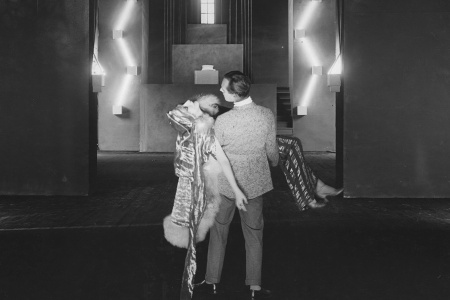
One year before the Exposition internationale des Arts Décoratifs et industriels modernes in 1925, which would give rise to the concept of Art Deco, Marcel L'Herbier set out to create a major work. With "L'Inhumaine", together with outstanding artists of his generation, he created a synthesis of all the arts, just as the theorist Ricciotto Canudo had demanded of cinema. His manifesto for modern French art and technology combines design by Alberto Cavalcanti, Claude Autant-Lara and Fernand Leger, architecture by Robert Mallet-Stevens, costumes by Paul Poiret, furniture by Pierre Chareau and Michel Dufet, ballet by Jean Börlin and now lost music by Georges Antheil and Darius Milhaud to create a great synthesis of the arts.
Characterised by a mechanical aesthetic, an abstract montage, a fragmentation of objects and the dream of a panoptic vision, the film not only bears eloquent witness to how this important group of artists from all disciplines imagined the unification of modernity and technology, but also how the French universalism of the 1920s staged the categories of the human and the inhuman. The embodiment of inhumanity, the opera diva Claire Lescot, only returns to humanity when she is introduced to the fantastic world of the latest technology by the scientist Einar Norsen and ultimately literally brought back to life.
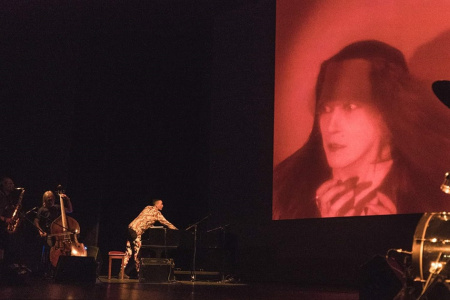
The IOIC is showing the film with a new live score. The six-member IOIC Fitzcarraldo Ensemble with improvising musicians from various genres - classical, jazz, pop and experimental music - will musically translate the two central themes of the film: Technology vs. modernity and humanity vs. inhumanity. In addition to traditional and modern instruments, various self-made electronic devices will also be used, which serve as extensions of the human body and have been specially constructed for this new soundtrack.
"The head is round so that thoughts can change direction". With this sentence, Francis Picabia characterised a time when the world was in ruins and a young movement of artists also saw art in ruins. So they rethought everything, did everything differently, including, of course, in the new medium of cinema. The overwhelming cascades of images by the artist Fernand Leger in "Ballet mécanique", which forms the overture to "L'Inhumaine" in this programme, are eloquent testimony to this irrepressible will to resurrect the new art like a phoenix from the ashes.